

SKIN LINE · CONCERNS
Петна по кожата
why they appear and what we can do about them
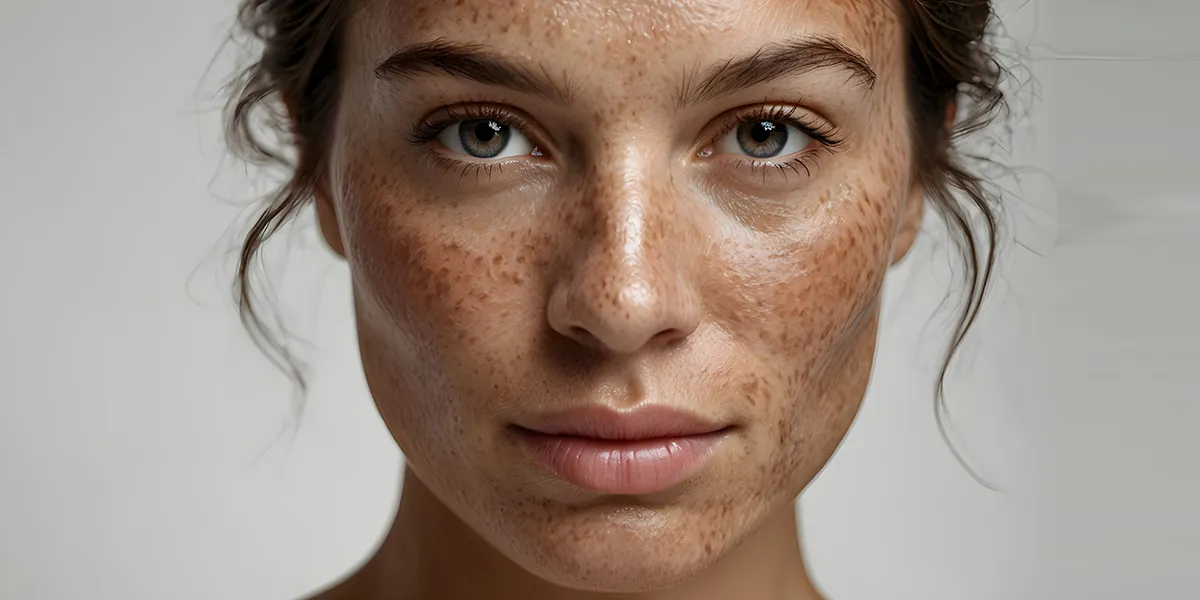
Петната по кожата могат да се появят при хора от всяка възраст и да имат множество различни причини. Те могат да бъдат по-светли или по-тъмни от околната кожа, червеникави, кафяви или сивкави и да се различават значително по размер, форма и разположение. В много случаи са безобидни и представляват нормална промяна в пигментацията, но понякога могат да бъдат свързани с кожно заболяване или друго състояние, което изисква медицинска оценка.
The appearance of spots on the skin is often associated with sun exposure and natural ageing, but the causes can be much more varied. Hormonal changes, inflammation, medication, infections, autoimmune conditions and genetic factors can also alter skin colour.
Therefore, the approach to pigmentation changes should not be the same for everyone. Before starting any skin-lightening cosmetics or treatments, it is important to determine the cause of the specific patch. Modern dermatology offers a range of options for diagnosing, managing and improving various types of skin patches.
Какво представляват петната по кожата?
Skin patches are areas that differ in colour from the surrounding skin. They may result from an increased or decreased amount of melanin, dilated blood vessels, inflammation or other changes in the skin’s structures.
In hyperpigmentation, the skin produces or accumulates more pigment, and the affected area appears darker. In hypopigmentation, the amount of melanin is reduced, making the area lighter. In depigmentation, the pigment may be almost completely absent.
The appearance of the patches alone is not sufficient to determine their cause. For example, a brown patch could be a solar lentigo, melasma, post-inflammatory hyperpigmentation or another type of pigmented lesion.
Това е причината професионалната диагностика да има толкова голямо значение. Особено при новопоявили се, бързо променящи се или нетипични петна е важно първо да се изключат потенциално сериозни причини.
Видове петна по кожата
Петната по кожата могат да бъдат разделени на различни групи според цвета и причината за тяхната поява.
Sunspots – also known as solar lentigines, these are flat brown patches that most commonly appear on areas exposed to prolonged sunlight – the face, neckline, arms and shoulders. They become more common with advancing age.
Melasma – characterised by brownish to grey-brown patches, most commonly on the face. They are usually symmetrical and may be linked to hormonal factors and exposure to light.
Post-inflammatory hyperpigmentation – occurs following inflammation or damage to the skin, for example after acne, eczema, sunburn or other trauma. It is more commonly seen in darker skin types.
Freckles – small pigmented spots that are linked to genetic factors and become more pronounced with sun exposure.
Hypopigmented and depigmented patches – these lighter areas may be associated with various conditions, including vitiligo, certain fungal infections or other dermatological problems.
Red patches – these are not necessarily pigmented. They may result from inflammation, dilated blood vessels, an allergic reaction or another skin condition.
Именно голямото разнообразие от причини показва защо всяко петно трябва да бъде оценявано според неговите конкретни характеристики.
Причини и рискови фактори за появата на петна по кожата
There are numerous causes of skin spots. One of the most important factors is exposure to ultraviolet (UV) radiation. UV radiation stimulates the production of melanin and, with chronic exposure, can lead to pigment accumulation and the appearance of sunspots.
Other factors include:
- hormonal changes, including during pregnancy;
- genetic predisposition;
- inflammatory skin conditions;
- акне и други възпалителни процеси;
- кожни травми и изгаряния;
- certain medicines;
- certain infections;
- естественото стареене на кожата;
- автоимунни заболявания при определени видове депигментация.
При някои хора кожата реагира с по-активно производство на меланин след възпаление. Това обяснява защо след пъпки, рани или други раздразнения могат да останат кафеникави следи.
Хормоните също могат да имат значение. Мелазмата например често се появява или задълбочава при бременност или при употреба на определени хормонални препарати.
Генетичните фактори определят до известна степен склонността към лунички, определени видове невуси и други пигментни особености.
Are skin patches a medical condition?
The mere presence of skin patches does not necessarily indicate a medical condition. Many pigmentary changes are entirely benign and do not require treatment.
At the same time, some spots may be a sign of a dermatological condition. Others, although less common, may represent precancerous or malignant skin changes.
Particular attention should be paid to new or changing pigmented lesions. Melanoma, for example, may appear as a new spot or develop within an existing pigmented lesion.
It is therefore incorrect to classify every brown spot as ‘pigmentation’ and to treat it with skin-lightening products without prior assessment.
When should you see a doctor?
A dermatological examination is recommended for any spot that looks unusual or changes over time.
Consult a specialist if:
- the spot is growing rapidly;
- it changes shape or colour;
- it has irregular or blurred edges;
- it contains several different colours;
- it starts to bleed or forms an ulcer or sore;
- сърби или боли продължително;
- a new, unusual patch appears;
- има внезапна поява на множество пигментни промени.
When assessing pigmented lesions, a dermatologist may use dermatoscopy, which allows for a detailed examination of the structures within the skin that are invisible to the naked eye.
If a lesion raises concerns, the doctor may recommend a biopsy or its complete removal for histological examination. This is particularly important when melanoma or another skin condition needs to be ruled out.
Daily home care for skin patches
Regardless of the type of patch, sun protection is a key part of care. Ultraviolet radiation can exacerbate many types of hyperpigmentation and make existing patches more noticeable.
It is recommended to use a broad-spectrum sunscreen with a high SPF daily, particularly on exposed areas of the body. During prolonged sun exposure, the sunscreen should be reapplied.
The skin should be cleansed gently, without aggressive scrubbing. It is also important to avoid using strong exfoliants or products that cause a burning sensation or irritation on your own.
For those prone to pigmentation, suitable active ingredients such as niacinamide, vitamin C, azelaic acid or other agents may be incorporated, depending on individual needs.
Home remedies for managing the condition and home care measures
Home care can help manage certain types of pigmentation, but it should not replace a dermatological diagnosis.
The most important measures are daily sun protection, gentle cleansing and adequate moisturising. In cases of confirmed hyperpigmentation, cosmetic products containing proven active ingredients, selected according to skin type, may be used.
It is not advisable to use popular home remedies involving lemon juice, vinegar, bicarbonate of soda or concentrated essential oils. These can irritate the skin and cause inflammation, which, in skin prone to pigmentation, may lead to even darker patches.
It is also important not to attempt to remove or ‘burn off’ an unknown pigmented lesion yourself. Before any procedure, the spot must be correctly identified. Skin spots have numerous possible causes and cannot be treated as a single problem. In many cases, they are entirely benign, but a change in appearance, rapid onset or atypical characteristics are reasons to consult a dermatologist. An accurate diagnosis allows the most appropriate treatment method to be selected and helps to avoid procedures that could worsen the condition.
Modern solutions for tackling the problem
The treatment of skin spots depends entirely on their cause. This is particularly important because a method that is suitable for one type of pigmentation may be ineffective or even unsuitable for another.
In cases of hyperpigmentation, a dermatologist may recommend topical depigmenting agents that inhibit the formation or transfer of melanin. Ingredients used include azelaic acid, retinoids, vitamin C, kojic acid and other active substances. Hydroquinone is also an effective depigmenting agent, but its use must comply with medical indications and local regulations.
In certain cases, chemical peels may be used to accelerate the renewal of the skin’s surface layers.
Modern aesthetic dermatology also utilises various laser and light-based technologies for the treatment of certain pigmented lesions. Lasers are not a one-size-fits-all solution for all types of spots, and the incorrect choice of technology or settings may cause burns, inflammation or further pigmentation.
For some sun-induced lesions, procedures such as laser treatment, IPL or other methods may be suitable, but only following an accurate diagnosis.
Най-добрият подход обикновено е комбинация от професионално лечение и постоянна домашна грижа, като целта е не само изсветляване на съществуващите петна, но и предотвратяване на появата на нови.
A personalised approach to your skin
Discuss your condition and treatment options with a specialist from Skin Line.
Clinics in Varna, Plovdiv and Sofia.
Treatment options
-
-
-18%

Lumenis Stellar M22 Photofacial full face and neck
Original price was: 281€.230€Current price is: 230€.Sofia

Your care begins with a consultation
Choose a clinic that suits you and get in touch with our team.

